Ryunosuke Akutagawa · Kanto, Tokyo
Following Ryunosuke Akutagawa's Spinning Gears to Tokyo's Ginza and Nihonbashi: A Literary Travel Guide
Trace the real Tokyo behind Akutagawa's Spinning Gears: the Imperial Hotel in Hibiya, Ginza's main street, and the Nihonbashi bookstore that inspired it.
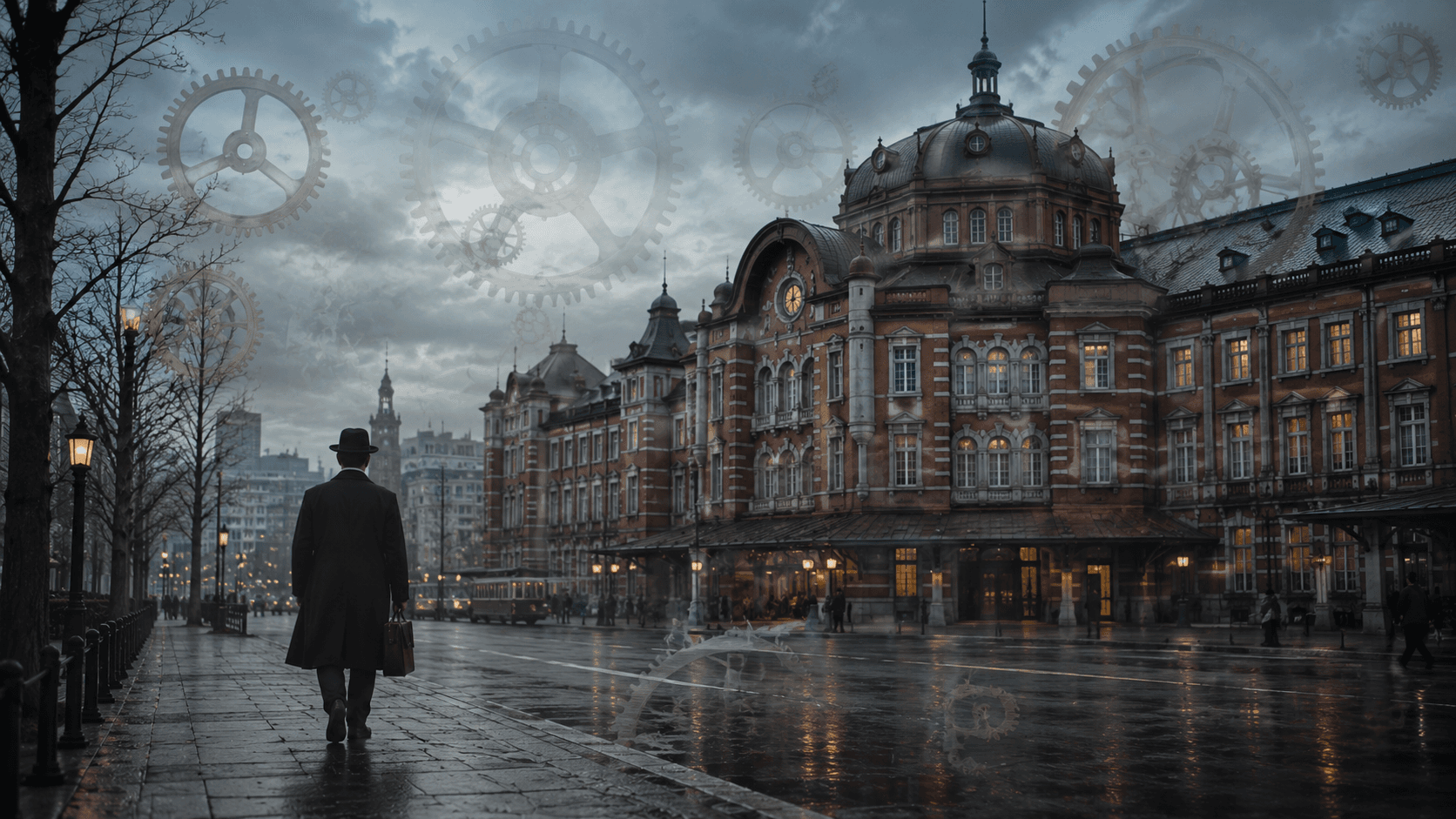
A gear appears at the edge of his vision first — half-transparent, spinning, gone the moment he turns to look straight at it. Then another, and another, until they won't leave him alone.
This is how Spinning Gears (歯車, Haguruma) begins for Ryunosuke Akutagawa's narrator, who walks through an ordinary Tokyo evening — a hotel, a crowded shopping street, a bookstore — and finds none of it ordinary anymore. The crowd seems too cheerful. The city seems to know something he doesn't.
Walk north on Ginza's main street at dusk and you can feel a version of it too, that low-grade sense that something is pressing in just out of sight. Akutagawa wrote the story in the last weeks of his life, and it barely bothers to disguise itself: the hotel his narrator keeps returning to, the bookstore where a poster catches him off guard, the gears themselves — all of it drawn from Akutagawa's own final months, months before he took his own life that July.
This guide follows the short, walkable route at the center of the story: the hotel where he stayed that spring, the street he paced through in growing unease, and the bookstore where the visions caught up with him again.
Stop 1: The Imperial Hotel, Hibiya — where the gears first appeared, and where his own crisis came to a head
Spinning Gears opens with the narrator dashing by car and train from a countryside resort to reach Tokyo in time for a friend's wedding reception. Walking the last stretch toward the hotel, tired and irritable, he notices something at the edge of his vision: a half-transparent, spinning gear, the first of the hallucinations that recur through the rest of the story.
He checks into a room and keeps returning to it across several unraveling days — in the story, drafting the very account we're reading in between short trips out into the city. It's in this room that he learns his brother-in-law has been killed, struck by a train while wearing a raincoat out of season.
Akutagawa's own brother-in-law died the same way that January, in an accident tangled up with debt and suspected arson, six months before Akutagawa's own suicide — some accounts describe it as closer to a deliberate death than a straightforward accident. The raincoat itself, as far as biographers have traced it, doesn't match contemporary reports of the real man's death. It looks like a detail Akutagawa's own mind supplied, which may be exactly why it keeps coming back to haunt the narrator for the rest of the story.
The hotel's hold on Akutagawa that spring went further than the fiction lets on, and this is worth slowing down for. By most biographical accounts, in the same weeks he was finishing this story, he tried more than once to arrange a lovers' suicide pact at the Imperial Hotel with a woman close to his household, named in most sources as Masako Hiramatsu. Each time, she changed her mind and fled before anything happened.
Stand in that lobby with that in mind and the hotel stops being just a "setting" for the story. It's a place where something real and almost unbearable nearly happened, twice, to the man writing the book — before he ever put a fictional gear in his narrator's eye.
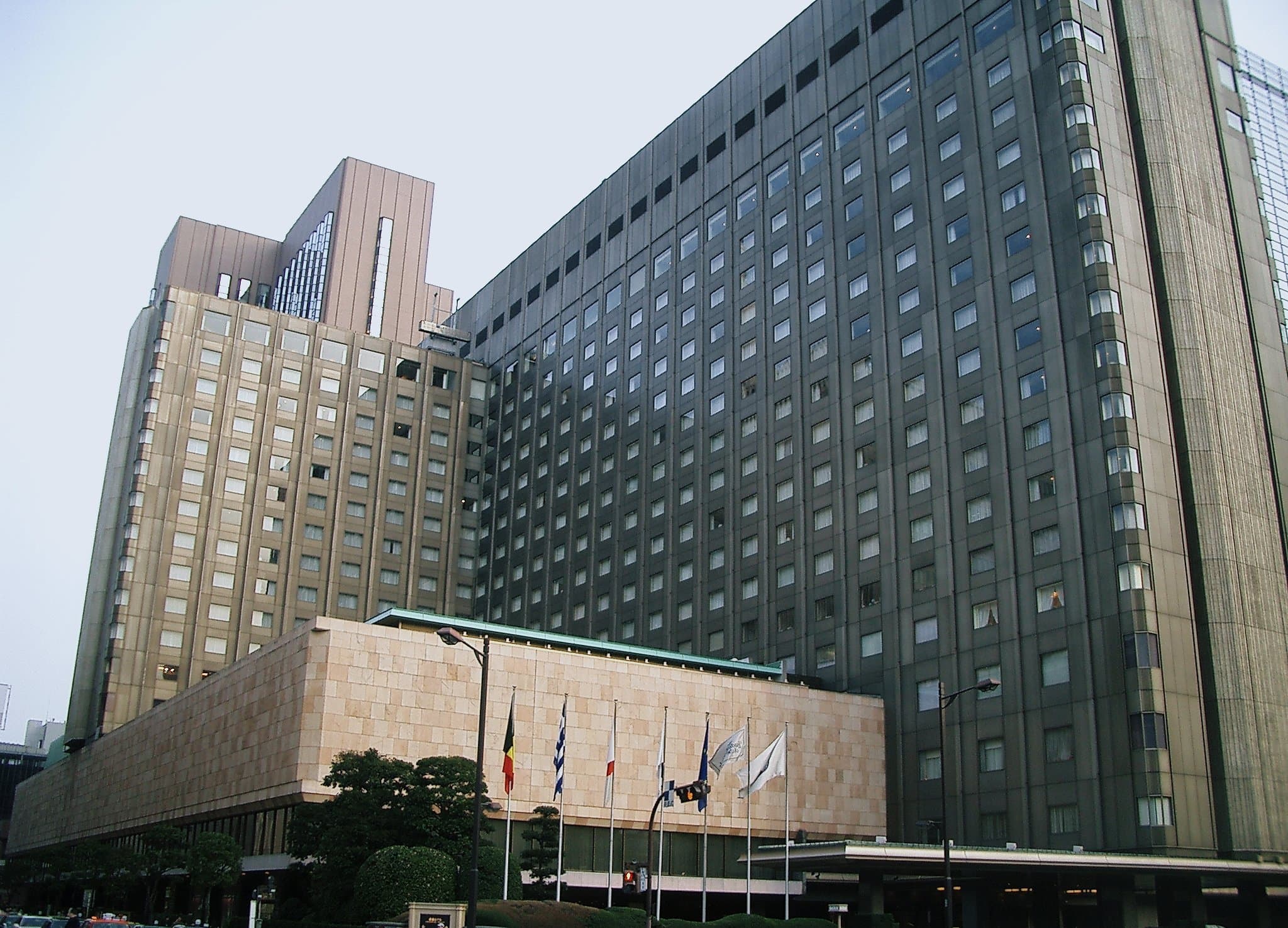
The narrator never names the hotel, but it's identified as the Imperial Hotel — at the time, still Frank Lloyd Wright's dramatic 1923 building. That structure is gone now; it was demolished in 1968, and its striking main entrance was eventually dismantled and rebuilt at the Meiji-mura architecture museum in Inuyama, Aichi, far from Tokyo. The Imperial Hotel itself never closed, though — a later building has stood on the same Hibiya site ever since, across the street from Hibiya Park.
- Getting there: Hibiya Station (Hibiya, Chiyoda, and Mita lines), about 2 minutes on foot; also a short walk from Yurakucho or Ginza stations.
- Good to know: One scene plays out right at this entrance — the narrator, arriving back after visiting a mental hospital, finds a man in a raincoat arguing with the hotel valet and turns around without going inside, spooked by the coincidence.
Stop 2: Ginza-dori — the street he paced through in the fading light

Restless in his room, the narrator heads out to Ginza's main street as evening falls, walking north through the crowd. The shops and passersby around him seem untouched by guilt or dread, which only deepens his own. He ducks into a bookstore piled with magazines, picks up a children's book of Greek myths almost at random, and one line inside it hits him hard enough to stop him where he stands — though even Akutagawa never tells us what the line said.
Ginza-dori — officially Chuo-dori along this stretch — is still Tokyo's best-known shopping street, though department stores and flagship boutiques have long since replaced the small bookshops of the 1920s. The story never names the exact shop, so treat this as the real street behind that walk rather than a single marked storefront.
- Getting there: Ginza Station (Ginza, Marunouchi, and Hibiya lines) sits right on the street; Higashi-Ginza Station is a couple of minutes' walk away, near Kabukiza.
- Good to know: On weekends and holidays, Chuo-dori through Ginza closes to cars for a few afternoon hours and becomes a pedestrian-only "hokosha tengoku" — about as close as a modern visitor gets to walking this street the way Akutagawa did. Check current hours before you go, since the schedule shifts from time to time.
Stop 3: Maruzen Nihonbashi — where the gears came back

Maruzen is the one place in Spinning Gears Akutagawa names outright. Its celebrated red-brick Nihonbashi building, with a second-floor foreign-books hall, had opened in 1910; it burned in the fires that followed the 1923 Great Kanto Earthquake, and by the time Akutagawa visited in April 1927, Maruzen had rebuilt on the same site.
Inside, the narrator pulls August Strindberg's Legends off a shelf and finds it unsettlingly close to his own experience — the Swedish playwright wrote it during his own bout of paranoid delusion. It's the first of three unsettling recognitions in this store, each landing a little harder than the last.
He then opens a German-published book of psychiatric patients' artwork and finds a full page of figures with gears instead of faces, echoing exactly what keeps intruding on his sight. Picking up a copy of Madame Bovary — a novel he's already read many times over — he recognizes himself in its bored, provincial husband.
Wandering into the store's print gallery afterward, one more thing catches him off guard: a poster of a knight spearing a winged dragon. The Japanese word for dragon, ryu (龍), is the same character buried in Akutagawa's own given name, Ryunosuke (龍之介). It's hard not to read that as the story's cruelest joke on its own author — a coincidence the narrator can't shake, sitting right there in the print he's looking at.
That's the gut-punch of the whole story, tucked into a single throwaway image in a bookstore print gallery. Stand in front of that same gallery today and it's worth pausing there a moment, the way the narrator never quite manages to.
Maruzen has sold books on this Nihonbashi site since 1870, though the building itself has been rebuilt more than once, including after wartime bombing. Its current store, inside the Nihonbashi Maruzen Tokyu Building, still sells books a few minutes' walk from Nihonbashi Bridge.
- Getting there: Nihonbashi Station (Tozai, Ginza, and Toei Asakusa lines), directly connected to the building.
- Good to know: The story has the narrator step out afterward onto an already-quiet, dark Nihonbashi-dori — today the street stays lively well into the evening, so go expecting ordinary foot traffic rather than the empty road in the text.
Practical travel notes
- Best time to visit: Any season works. The roughly 2.7km walk from Hibiya through Ginza to Nihonbashi takes well under an hour at an easy pace, tracing something close to the narrator's own route. Go on a weekend afternoon if you also want to catch Ginza's car-free hours.
- Base yourself in: Central Tokyo — all three stops sit within an easy walk of Tokyo Station, close enough to combine into a single afternoon rather than a dedicated trip.
- Language: English signage is standard throughout central Tokyo; nothing about this route needs special preparation.
- The book itself: the standard English translation, titled Spinning Gears, is by Jay Rubin, collected in Rashomon and Seventeen Other Stories (Penguin Classics), with an introduction by Haruki Murakami. It has also been published as Cogwheels, translated by Cid Corman and Susumu Kamaike.
Tabi Tales may earn a commission from hotel, tour, and book links on this page at no extra cost to you. See our affiliate disclosure for details.