Following Tatsuhiro Oshiro's Cocktail Party to Okinawa's Kadena and Ginowan: A Literary Travel Guide
Understand the real scale of U.S. base presence behind Oshiro's Cocktail Party — Okinawa's first Akutagawa Prize winner — at the sites where that presence is still impossible to ignore today.
The party that opens Cocktail Party is almost aggressively pleasant — neighbors and colleagues trading the easy small talk of people who genuinely like each other, Chinese, Okinawan, and American voices mixing at a table like the friendship costs nothing. Then the narrator's daughter is assaulted by a U.S. serviceman, and every one of those friendships turns out to be load-bearing in exactly the way small talk isn't.
The case he tries to bring against the men involved exposes how little legal protection actually existed underneath all that warmth. Here's the detail that makes the novella harder to shake than a straightforward protest story: Oshiro never lets you pin down whether the narrator himself is Okinawan or mainland Japanese, and by the second half of the book he's narrating in second person, addressing his own protagonist as "you" — as if identity itself is one more thing occupation doesn't let a person hold onto cleanly. Friendship, the novella argues, was never the same thing as protection.
A novel of occupation-era Okinawa, from the inside
Tatsuhiro Oshiro was born in 1925 in Nakagusuku Village, central Okinawa, and lived through the Battle of Okinawa and the 27 years of U.S. administration that followed before reversion to Japan in 1972 — the same world Cocktail Party is set in. Published in 1967, it became the first work by an Okinawan-born author to win the Akutagawa Prize.
The novella opens at a friendship party inside a U.S. military housing compound, and that surface of easy goodwill is what collapses over the course of the book. What follows here isn't a pilgrimage to fictional addresses — no building in Okinawa is "the" cocktail party house — it's a trip to the real conditions the book assumes its readers already understand.
Stop 1: Michi-no-Eki Kadena — seeing the scale the novel takes for granted
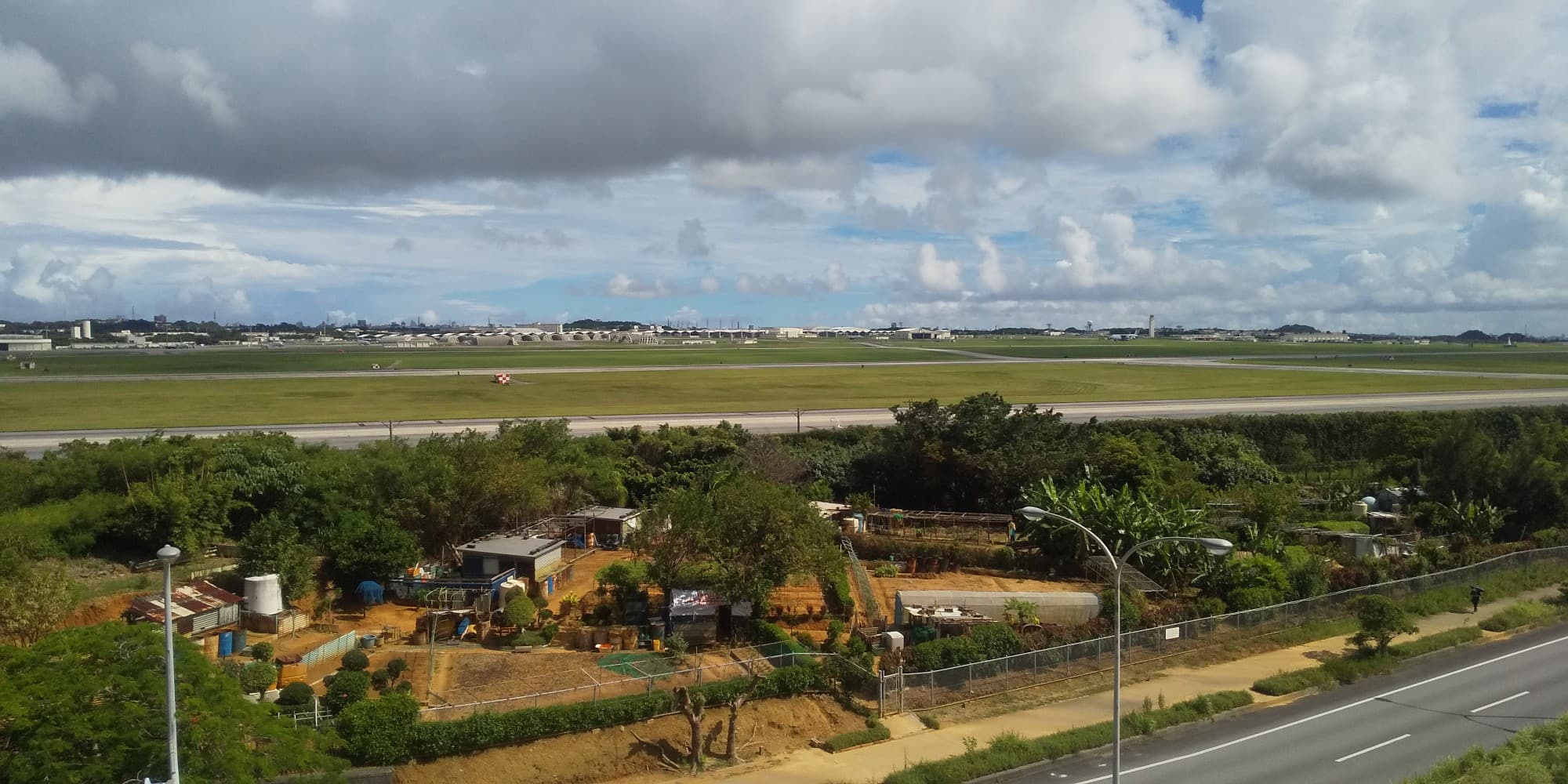
No single building is confirmed as a location from the novel, but understanding Cocktail Party means understanding just how much of Okinawa the U.S. military occupies — a reality the book assumes its readers already live with, and one many visitors don't grasp until they see it. Michi-no-Eki Kadena, a roadside station in Kadena Town, is the only public facility in Japan with a direct view into an active U.S. base: its 4th-floor observation deck looks straight out over Kadena Air Base, the largest U.S. base in Japan.
A 3rd-floor exhibition room fills in the history — before, during, and after the war — including the fact that roughly 82% of Kadena Town's land is still occupied by the base today. That number is easy to read past on a page. It means most of the town you're standing in doesn't legally belong to the town, and a runway filling the entire view from the deck is what actually makes that sink in rather than just register.
- Getting there: About 30 minutes by car or taxi from Naha. Okinawa has no train network outside Naha's Yui Rail monorail, so a rental car or taxi is the practical way to reach Kadena.
- Good to know: Fighter jet takeoffs and landings are visible, and audible, from the deck, heavier on weekdays and quieter on weekends and U.S. holidays. The exhibition room is a calmer, more informative stop if the noise is more than you'd bargained for.
Stop 2: Sakima Art Museum, Ginowan — land taken by a base, and taken back
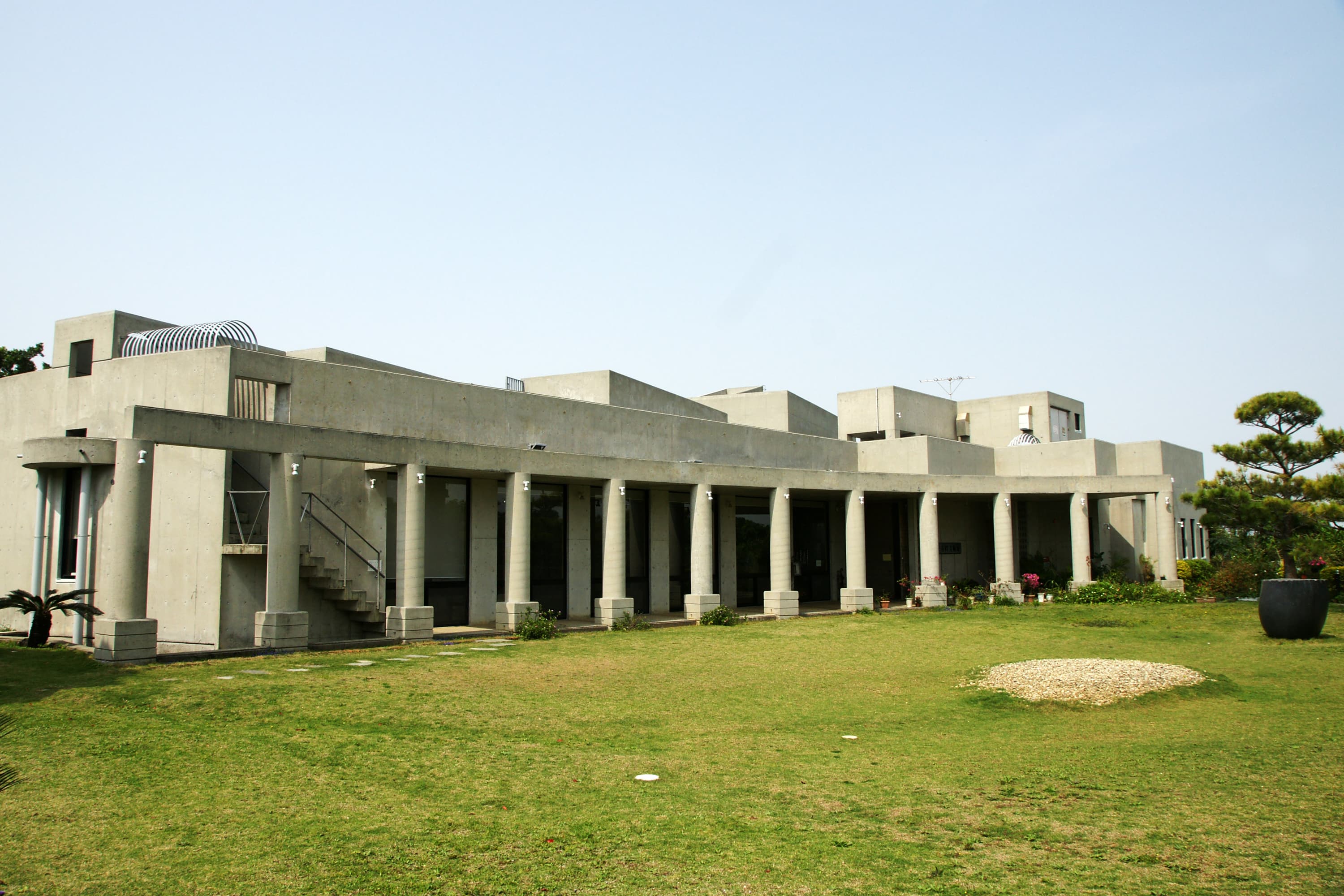
The land the Sakima Art Museum sits on belonged to the family of its director, Michio Sakima, before the war. It was requisitioned into what's now Futenma Air Station and stayed inside the base's perimeter for decades — the same slow, ordinary theft the novella's characters live with and rarely name out loud.
Sakima spent years negotiating its release, one narrow parcel at a time, and in 1994 he built a museum on that small reclaimed patch of ground, inside the fence line of the base that had once swallowed it whole.
A family got its land back one parcel at a time, then built a staircase to watch the sun set over the day the killing stopped.
That's the story worth sitting with before you even get to the art. The museum's centerpiece is The Battle of Okinawa (沖縄戦の図), a large-scale permanent mural by Iri and Toshi Maruki, the same husband-and-wife artists known for their Hiroshima Panels. It rewards slow, unhurried looking, not a quick pass-through — give it the time the war it depicts never gave anyone.
By some accounts, the building's rooftop staircase was designed to align with the sunset on June 23, Okinawa's Irei no Hi memorial day marking the end of the battle. Whether or not that alignment is exact, the staircase does offer its own view straight over Futenma's runways — land taken and land returned, in the same sightline.
- Getting there: Roughly 30–50 minutes by car from Naha. Public transit is limited — check current bus routes toward Ginowan before relying on one, and budget for a taxi or rental car if you want certainty.
- Good to know: Kadena and Sakima sit in different parts of central Okinawa, roughly 20–25 minutes apart by car, so plan on a half-day at minimum to combine them with a rental car. Give the museum real time rather than rushing through — the mural is meant to be sat with.
Practical travel notes
- Best time to visit: June 23 (Irei no Hi) gives the Sakima Art Museum's rooftop a significance it doesn't have on an ordinary day, but avoid the peak of summer if you can — Okinawa's July–August humidity is brutal and June–October is typhoon season, which matters for an open-air observation deck and a rooftop staircase.
- Base yourself in: Naha, Okinawa's capital, is the practical hub for reaching both Kadena and Ginowan.
- Language: Michi-no-Eki Kadena's exhibition room has some English signage; expect mostly Japanese elsewhere at both stops.
- The book itself: the standard English translation, titled Cocktail Party, appears in Okinawa: Two Postwar Novellas (Institute of East Asian Studies, UC Berkeley).
Tabi Tales may earn a commission from hotel, tour, and book links on this page at no extra cost to you. See our affiliate disclosure for details.