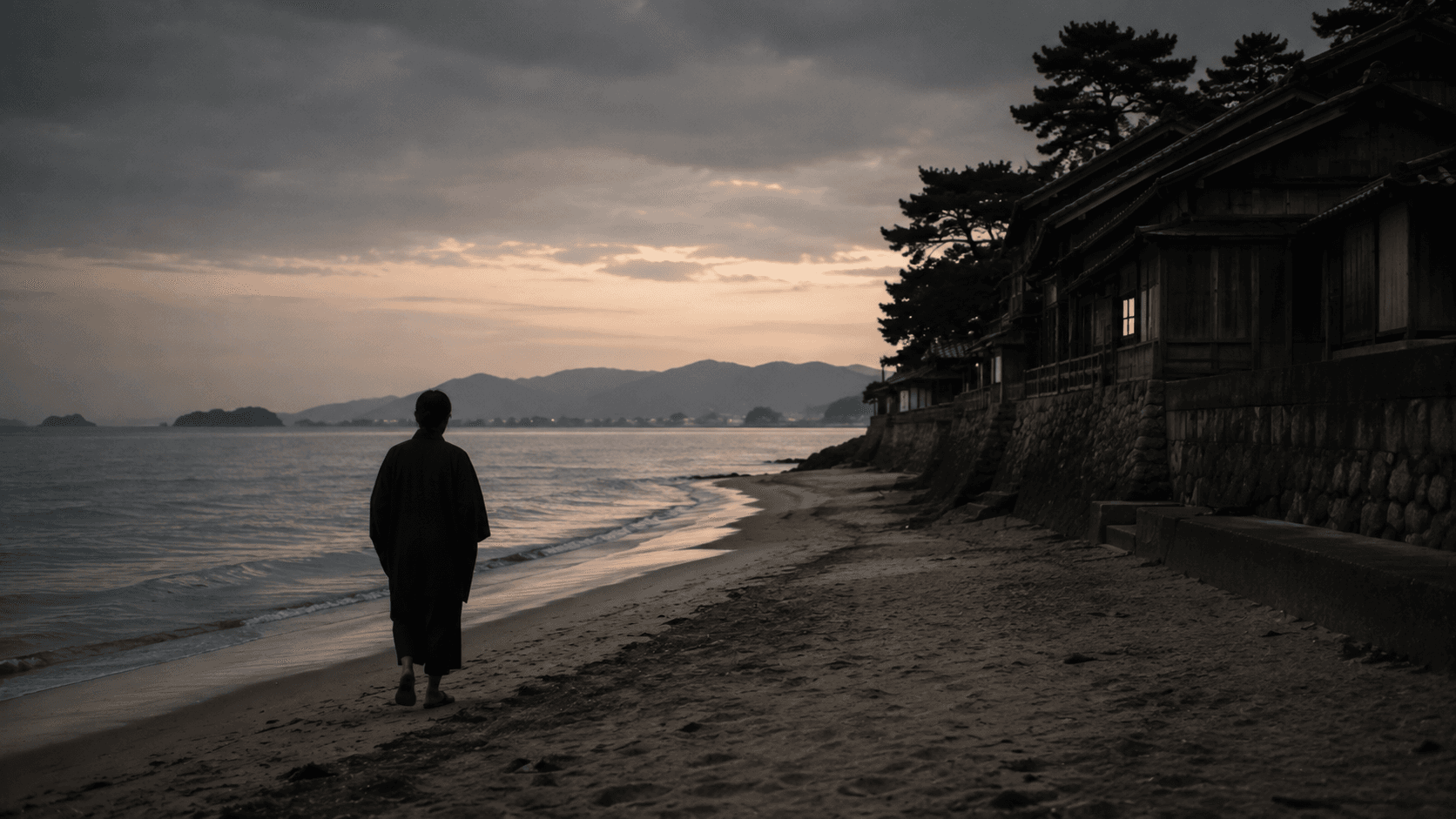
Osamu Dazai · Kanto, Tokyo, Kanagawa
Following Osamu Dazai's No Longer Human to Tokyo and Kamakura: A Literary Travel Guide
Trace the real Tokyo and Kamakura settings behind Dazai Osamu's No Longer Human — from the coastal cape where his own life nearly ended to the Mitaka neighborhood where he wrote the book and is buried.
No Longer Human - Dazai Osamu
Osamu Dazai
No Longer Human is a deeply introspective exploration of alienation, identity, and the struggle for self-acceptance in a rapidly changing society. Osamu Dazai presents the fragmented life of Ōba Yōzō, a man unable to reconcile his outward persona with his inner despair, navigating a world where human connection feels impossible and authenticity seems unattainable. Through a series of confessional notebooks, the narrative confronts the psychological disintegration of its protagonist, revealing the corrosive effects of isolation, guilt, and societal expectations. Since its publication, No Longer Human has been recognized as one of the most significant works of modern Japanese literature, praised for its unflinching honesty and emotional depth. Its exploration of universal themes such as the fear of rejection, the search for meaning, and the destructive consequences of self-alienation has resonated with readers across cultures and generations. The novel's stark portrayal of mental anguish and existential crisis continues to speak to those grappling with the tension between their inner selves and the facades they present to the world. The enduring power of No Longer Human lies in its capacity to strip away illusions and confront the raw, uncomfortable truths about the human condition. By examining the fragile boundaries between authenticity and performance, belonging and estrangement, Dazai invites readers to reflect on the cost of disconnection — and on the profound human need for understanding, compassion, and genuine connection.
"I have lived a life of much shame." That's the line No Longer Human (人間失格, Ningen Shikkaku) opens on, more or less, and it doesn't let up for the rest of the book. A young man narrates his own slide into alcoholism, addiction, and a kind of isolation that never quite has a name — this is a confession, not a plot. Where Tsugaru shows Dazai at his warmest, revisiting the rural hometown he loved, this one is almost entirely urban and unsparing.
Dazai completed the manuscript in May 1948. He died by suicide that June, weeks into the novel's serialization in the magazine Tenbo — before readers had even reached the final installment. It's his most famous novel and one of the best-selling works in modern Japanese literature.
Read alongside our guide to Tsugaru, it shows the other side of the same writer. This guide follows the two real places most directly tied to the novel and to Dazai's own life: the Kamakura coast behind its darkest scene, and the Tokyo neighborhood where he wrote it and is buried.
The story behind the notebooks
The novel is framed as three notebooks written by a man named Yōzō, bracketed by a short preface and afterword narrated by someone else entirely. In the afterword, the narrator tracks down the notebooks at a bar in Kyobashi, central Tokyo, where the bar's madam had kept them for years. Worth remembering as you read the rest of this guide: Yōzō is a character, not Dazai himself, even where the novel borrows heavily from his own life.
Stop 1: Koyurugi-misaki, Kamakura — the cape behind the novel's turning point
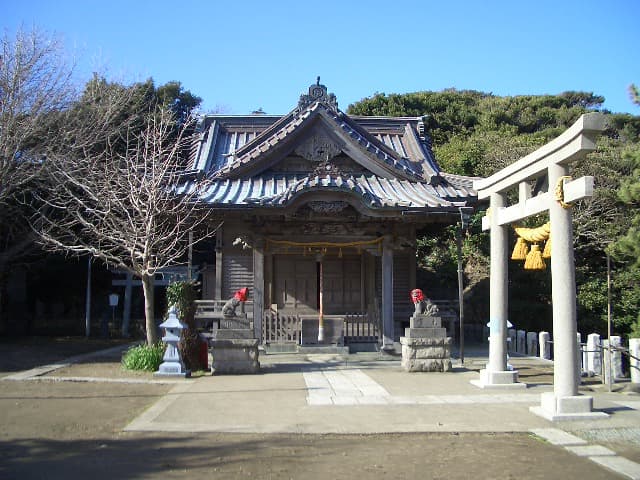
The novel's pivotal scene has Yōzō and a bar hostess named Tsuneko attempt to drown themselves together in the sea at Kamakura; only Yōzō survives. Dazai didn't invent this from nothing. In November 1930, as a 21-year-old university student, he and a 19-year-old Ginza bar hostess named Shimeko Tanabe took an overdose of sleeping pills at Koyurugi-misaki, a small cape in Kamakura's Koshigoe area.
Tanabe died. Dazai survived, and was never prosecuted. He carried that night with him for the rest of his life, and it resurfaces, transformed, in the novel's darkest turn.
Koyurugi-misaki is still there, and still worth the trip regardless of the literary connection: a small point between Shichirigahama and Koshigoe beaches, with Koyurugi Shrine at its tip and an observation deck looking out toward Enoshima. Stand at the railing and the water is just water — pretty, unremarkable, the kind of view that draws couples for the sunset. That gap between what the place looks like now and what happened here is worth sitting with for a minute before you move on.
The novel itself doesn't name the exact spot — it just says "the sea at Kamakura" — so treat this as the real-life site behind the scene rather than a location described in the text.
- Getting there: Koshigoe Station on the Enoden line, a short walk from the cape.
- Good to know: Come near sunset if you can — the light over Enoshima is part of why this stretch of coast draws people, heavy history and all.
Stop 2: Mitaka, Tokyo — where the book was written, and where Dazai's story ended
Dazai lived in Mitaka, a residential area in western Tokyo, from 1939 until his death in 1948 — the most productive stretch of his career, and the period that produced both No Longer Human and Tsugaru.
Weeks after finishing the manuscript, he drowned himself in the Tamagawa Josui canal that runs through the neighborhood, together with Tomie Yamazaki, a woman he had been involved with in his final years. Several sites within a short walk of Mitaka Station cover this whole arc — where he wrote, where he died, and where he's buried — and they're close enough together to see in a couple of unhurried hours.
- Dazai Osamu Literary Salon (太宰治文学サロン) — 3-16-14 Shimorenjaku, Mitaka, a few minutes on foot from the station's south exit. Manuscript reproductions, early editions, and photos from his Mitaka years; a guided literary walking tour runs monthly.
- Tamagawa Josui / "Kaze no Sanpo-michi" (風の散歩道) — the canal where Dazai and Tomie Yamazaki drowned themselves, now a shaded walking path from the station's south exit toward Kichijoji. A stone marker, Tamashika-ishi (玉鹿石), sits near where their bodies were recovered.
- Zenrin-ji Temple (禅林寺) — 4-18-20 Shimorenjaku, Mitaka; free to enter. The temple holds an annual memorial, Ōka-ki (桜桃忌), around June 19 — the day his body was found.
- Mitaka train yard footbridge (三鷹電車庫跨線橋) — a short walk from the station's west side, a spot Dazai was known to like; on clear days you can see Mt. Fuji past the rail yard.
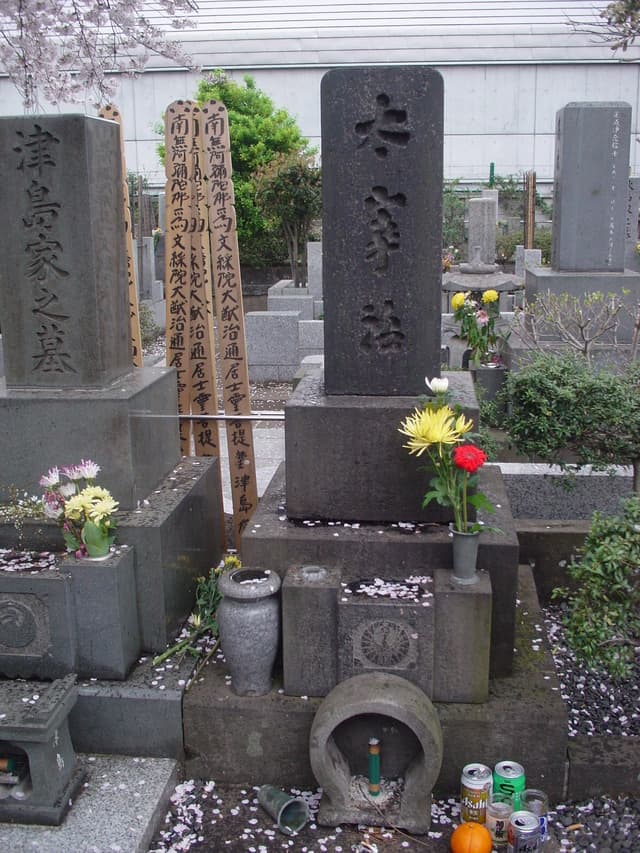
Save Zenrin-ji for last if you can. Dazai's grave is here, and by his own wish it faces that of novelist Mori Ogai, a writer he'd admired since long before he was famous himself.
His grave faces Ogai's — a lifetime of looking up to a writer, resolved into something as simple as which way a headstone points.
There's no plaque explaining that choice and none needed. It's the kind of detail that does more standing in front of it than it ever could on a page.
See the full route on Google MapsPractical travel notes
- Best time to visit: Kamakura gets crowded on summer weekends — a weekday or off-season visit makes Koyurugi-misaki much quieter. If the Ōka-ki memorial around June 19 interests you, expect a busier-than-usual Zenrin-ji.
- Base yourself in: central Tokyo works for both, but treat Kamakura and Mitaka as two separate outings rather than one day trip. They're on opposite sides of Tokyo with no direct connection between them — Mitaka is a quick hop from Shinjuku on the Chuo Line, while Kamakura is roughly an hour out on the Yokosuka Line. Each is an easy half-day or day trip on its own.
- Language: major train stations along this route are well signed in English. Smaller sites like the Literary Salon, Zenrin-ji, and the canal path marker are more hit-or-miss — a translation app is a good idea for those stops.
- The book itself: the standard English translation is Donald Keene's, published by New Directions.
Tabi Tales may earn a commission from hotel, tour, and book links on this page at no extra cost to you. See our affiliate disclosure for details.