Junichiro Tanizaki · Kanto, Tokyo, Kanagawa
Retracing Junichiro Tanizaki's Naomi to Yokohama's Foreign Quarter: A Literary Travel Guide
Follow the real 1920s Tokyo-to-Yokohama world behind Tanizaki's Naomi (Chijin no Ai) — including the Yamate hillside where the author himself lived out the novel's Westernizing obsessions.
Naomi
Junichiro Tanizaki
A hilarious story of one man’s obsession and a brilliant reckoning of a nation’s cultural confusion—from a master Japanese novelist. When twenty-eight-year-old Joji first lays eyes upon the teenage waitress Naomi, he is instantly smitten by her exotic, almost Western appearance. Determined to transform her into the perfect wife and to whisk her away from the seamy underbelly of post-World War I Tokyo, Joji adopts and ultimately marries Naomi, paying for English and music lessons that promise to mold her into his ideal companion. But as she grows older, Joji discovers that Naomi is far from the naïve girl of his fantasies. And, in Tanizaki’s masterpiece of lurid obsession, passion quickly descends into comically helpless masochism.
Picture a man teaching a fifteen-year-old café waitress to waltz in a rented Western-style house, correcting her posture, dressing her in imported clothes, falling for the "modern" woman he's building out of her piece by piece — and then slowly losing control of what he's made. That's Naomi (痴人の愛, Chijin no Ai, literally "A Fool's Love"), Junichiro Tanizaki's 1924–25 novel, and it's as much a comedy of obsession as it is a tragedy. It's also soaked in a very specific place and moment: Tokyo and Yokohama in the years just after World War I, when jazz, ballroom dancing, and Western fashion were remaking Japanese urban life so fast that the novel coined its own word for it — Naomizumu, "Naomi-ism" — for the modern-girl aesthetic it both mocked and helped sell.
A novel drawn from its author's own life
Tanizaki didn't invent this world; he was living in it. In 1921 he was renting a house next to a Western-style bar in Honmoku, on Yokohama's waterfront, and by 1922 he'd moved further up the hill to Yamate, the city's old foreign settlement. By his own account he took up ballroom dancing and Westernized his furniture and dress during this period — precisely the transformation Jōji pushes onto Naomi in the novel. A young woman named Seiko Furukawa, who was living with Tanizaki at the time, is widely — if not universally — cited as an inspiration for Naomi, though biographers differ on how directly the character maps onto her.
Then, in September 1923, the Great Kanto Earthquake ended this chapter of his life in a single day, forcing him to relocate to the Kansai region. He began serializing the novel the following year, looking back at a Westernized Yokohama life he'd already lost — which gives the book's nostalgia for jazz and dance halls and imported furniture an edge the story itself never quite says out loud.
In the story, Jōji and Naomi's world moves outward from central Tokyo — the cafés and "opera" theaters of Asakusa, where Naomi first works as a waitress; the dance hall culture around a fictional Ginza café called Eldorado, where Naomi's transformation is most on display; a small Western-style house in the suburbs at Omori, their first home together — before the final chapters relocate to a much larger Western house in Yokohama's old foreign settlement. None of Asakusa's 1920s cafés or Ginza's dance halls survive as identifiable sites today. The Yokohama end of the story does, and it's also the closest thing this trip has to Tanizaki's own address book.
Stop 1: Yamate, Yokohama — the hillside where Tanizaki lived this story
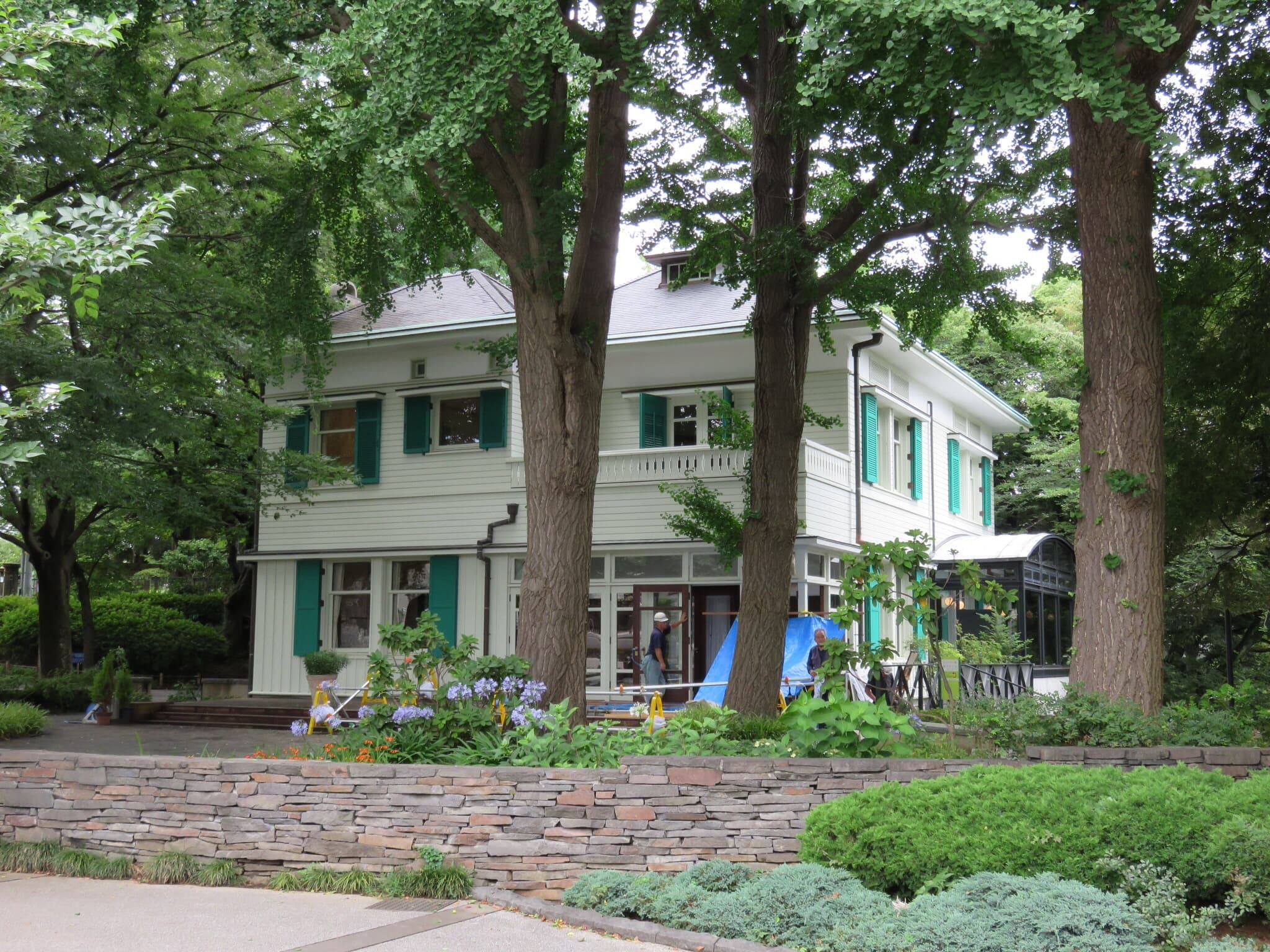
Yamate (山手) was Yokohama's designated foreign residential district from the 1860s on, and it's still full of preserved Western-style houses from roughly the period the novel is set in and Tanizaki lived through. A cluster of these houses, known collectively as the Yamate Western-style Residences (山手西洋館), are open to the public for free.
The centerpiece is the Ehrismann Residence (エリスマン邸), designed by Antonin Raymond, the Czech-American architect often called the father of Japanese modernism, for Swiss silk trader Fritz Ehrismann. Worth being honest about what this house is and isn't: it was built in 1925–26, after Tanizaki had already left for Kansai, so he never lived in it and Jōji's fictional Yokohama house isn't modeled on this specific building. What it gives you instead is the texture — the fireplace parlor, the combined living/dining room, the sunroom looking over the garden — of exactly the kind of imported, Westernized domestic life Tanizaki was chasing on this same hillside a few years earlier, and that Jōji chases through Naomi in the novel. Standing in these rooms is as close as this trip gets to the feeling behind the book, even if the address is a few doors down from the literal one.
There's a small café inside if you want to sit with that feeling a while before moving on.
- Getting there: Motomachi-Chukagai Station (Minatomirai Line), Exit 6, roughly a 10-minute walk uphill through Motomachi Park; or JR Ishikawacho Station, south exit, about 13 minutes.
- Good to know: Free admission, roughly 9:30–17:00, closed the second Wednesday of the month. Two other preserved houses nearby, Yamate 111-bankan and the Diplomat's House, each have their own small cafés, so it's easy to turn this into a slow afternoon.
- Worth the detour: The Motomachi shopping street below the hill is where Tanizaki himself wrote about walking excitedly as a self-declared "haikara" (fashionably Westernized) enthusiast — it's a good way to feel the same pull toward imported, Western things that runs through the whole novel.
- Nearby: The Yokohama Foreign General Cemetery and Minato no Mieru Oka Park (Harbor View Park) are a short walk further along the bluff, if you want to extend the visit.
Practical travel notes
- Best time to visit: Yamate's gardens are especially pleasant in spring; the houses themselves are indoor visits year-round.
- Base yourself in: central Tokyo or Yokohama itself both work — Yamate is about 30 minutes from central Tokyo by train.
- Language: well signed in English; this is one of Yokohama's standard tourist routes.
- The book itself: the standard English translation, titled Naomi, is by Anthony H. Chambers.
Tabi Tales may earn a commission from hotel, tour, and book links on this page at no extra cost to you. See our affiliate disclosure for details.