Haruki Murakami · Kanto, Tokyo
Following Haruki Murakami's 1Q84 to the Sangenjaya Expressway Stairs: A Literary Travel Guide
Find the real emergency staircase off Tokyo's Shuto Expressway where Aomame climbs down into an altered world at the start of 1Q84 — plus the real Koenji park and Azabu garden behind two of the novel's other key settings.
1Q84: Book 3
Haruki Murakami
Book Two of 1Q84 ended with Aomame standing on the Metropolitan Expressway with a gun between her lips. She knows she is being hunted, and that she has put herself in terrible danger in order to save the man she loves. But things are moving forward, and Aomame does not yet know that she and Tengo are more closely bound than ever. Tengo is searching for Aomame, and he must find her before this world's rules loosen up too much. He must find her before someone else does.
The taxi isn't moving. Aomame is stuck in traffic on the elevated Metropolitan Expressway, late for an appointment she can't afford to miss, when the driver says something that sounds like a warning dressed up as small talk: there's an emergency stairway nearby, if she really needs to get down. She takes it. A few dozen steel steps later, she's back on ordinary Tokyo streets — except nothing is quite ordinary again for the rest of the book.
That's the hook of 1Q84 (2009–10), and unusually for Murakami, part of it is genuinely walkable. Fans have identified a likely real-world staircase near Sangenjaya that matches the novel's description closely enough that it's become a minor pilgrimage spot, and the book's other key settings — Tengo's Koenji neighborhood, the Azabu garden widely thought to have inspired the wealthy dowager's "Willow House," even the small Chiba towns tied to both protagonists' childhoods — are mapped with a similar mix of real geography and fiction's usual vagueness. This guide follows all of it, staircase first.
Stop 1: The emergency staircase near Sangenjaya
Aomame's taxi is stuck on the Shibuya Route (3号渋谷線) of the Metropolitan Expressway near Sangenjaya, and the driver points her toward an emergency stairway close to the Ikejiri exit as a way down to Route 246 below. Murakami never pins the stairway to a single documentable spot — the novel is deliberately vague about exactly which maintenance stairway it is — but fans have converged on a real staircase in this stretch as the likely match, narrow and steel, spiraling down a support column, and some have marked it with "1Q84" graffiti over the years.
Don't expect to climb it. It's active expressway infrastructure, gated off for maintenance and emergency use, and there's no plaque or sign telling you what you're looking at — you're meant to stand on the ordinary street below and look up, the same ground-level view Aomame has just before she starts down.
- Getting there: From Sangenjaya Station (Tokyu Denentoshi Line), head toward Route 246 and the expressway overhead — the walk is short, a few minutes, but the staircase itself blends into the maintenance structure enough that it's easy to miss on a first pass. Bring a photo of the scene from the book or film adaptation to help you spot it.
- Good to know: This is a real piece of expressway infrastructure in an ordinary Tokyo neighborhood, not a tourist attraction. Traffic noise is constant and there's nowhere obvious to linger for long, so treat it as a five-minute stop rather than a destination to build an afternoon around.
Stop 2: Koenji Chuo Park — where Tengo watches two moons
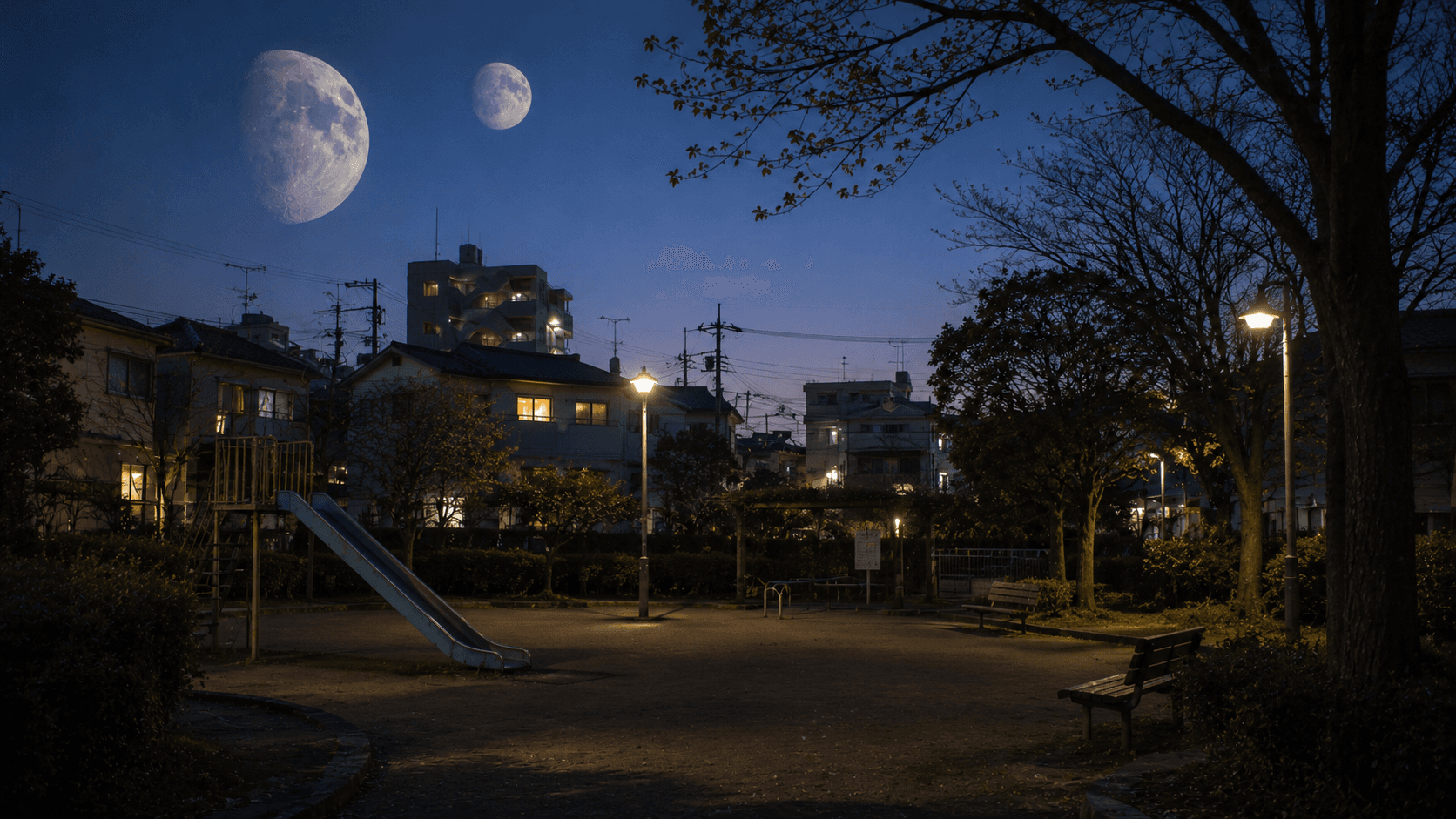
Tengo lives in Koenji, a quiet, walkable residential and shopping neighborhood in Suginami, for most of the novel's second half. It's in Koenji Chuo Park (高円寺中央公園), a small neighborhood park not far from the station, that he looks up one evening and notices a second moon hanging in the sky — the clearest sign yet that he, too, has slipped into the same altered world as Aomame. Aomame herself later moves to Koenji as well, making the neighborhood one of the few places in the novel both protagonists actually inhabit, even before they know it.
- Getting there: JR Chuo Line to Koenji Station; the park is a short walk from the south exit.
- Good to know: This is an ordinary neighborhood park, not a monument — nothing on site marks its connection to the novel. Koenji's real draw is its retro shopping arcades and secondhand clothing shops, easy to combine with the park visit.
Stop 3: Arisugawa-no-miya Memorial Park and Zenpukuji Temple, Azabu — the real "Willow House"
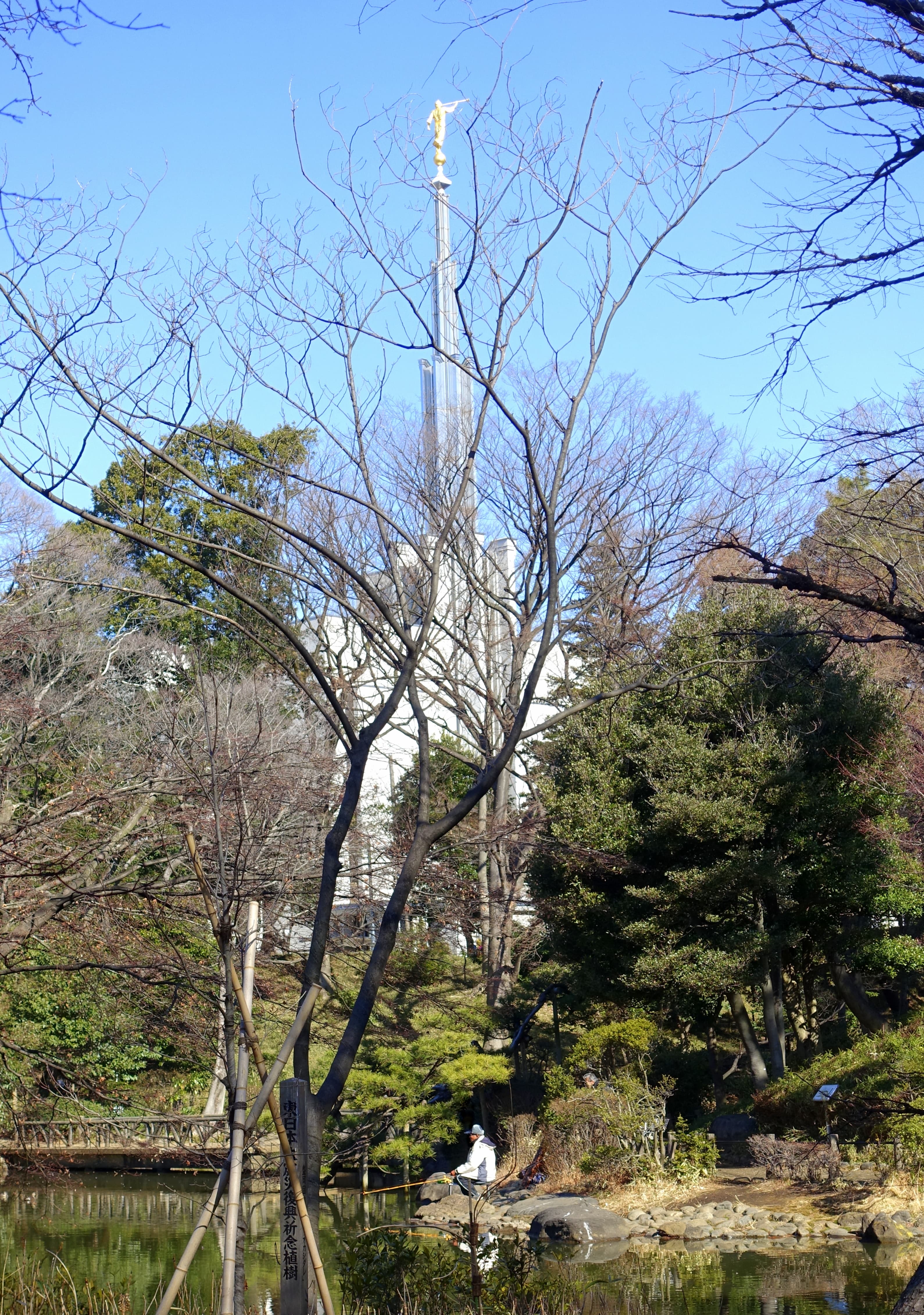
The novel's wealthy dowager lives in a mansion called the Willow House, in Azabu, one of Tokyo's most expensive residential districts. No single address is confirmed as the model, but fans and pilgrimage guides consistently point to Arisugawa-no-miya Memorial Park (有栖川宮記念公園) — a former Imperial family estate turned public park in Minami-Azabu — as the closest real match for the setting's quiet, moneyed atmosphere: hillside paths, old trees, the sense of old wealth just out of view behind hedges.
A short walk away, Zenpukuji Temple (麻布山善福寺) adds a thread worth following loosely rather than literally: its approach holds a well known as the "Willow Well" (柳の井戸), tied to a temple founding legend. Take it as an echo rather than proof — the temple's actual signature tree these days is a large old ginkgo, not a willow, so this is atmosphere borrowed from a name rather than a confirmed literary site.
- Getting there: Tokyo Metro Hibiya Line to Hiroo Station, about 3–5 minutes' walk to the park.
- Good to know: Both sites are free, outdoor, and open at all hours. Arisugawa Park has a pond, hillside paths, and a public library on its grounds — worth a visit even without the 1Q84 connection.
In the novel: further-flung locations
A handful of other real places round out 1Q84's geography — more for background color than as dedicated stops, but each carries a moment worth knowing before you pass through:
- Ichikawa, Chiba: The real hometown of both Aomame and Tengo, and textually significant for it — this is where the two share the same elementary school class and, in one wordless hallway moment, hold hands as children. That single memory is what both of them are, in different ways, still trying to get back to as adults.
- Chikura, Chiba: A real town on the Boso Peninsula, broadly associated with the "Town of Cats" story Tengo reads and half-lives inside — and where, in the novel, Tengo's father spends his final days in a sanatorium. Sitting with him there is some of the book's quietest, saddest writing.
- The Okura Tokyo, Toranomon: An important later scene is set at what the novel calls Hotel Okura. The hotel has since been rebuilt, reopening in 2019 as The Okura Tokyo — worth knowing going in, since the physical building you'll see isn't the one Murakami wrote.
- Shinjuku: The historic Nakamuraya building (新宿中村屋), near Shinjuku Sanchome, and the Kinokuniya main store across from it both still operate today and appear in the novel's Tokyo.
- Futamatao, Ome City: A remote station at Tokyo's western edge, near the mountain trailhead area where Fuka-Eri stays with Professor Ebisuno.
Practical travel notes
- Best time to visit: Any time — Sangenjaya, Koenji, and Azabu are all street-level city visits, not seasonal ones.
- Base yourself in: central Tokyo. Each stop sits within about 20–30 minutes of most central neighborhoods on its own train line, but the three aren't close to each other — Sangenjaya (Tokyu Denentoshi Line), Koenji (JR Chuo Line), and Hiroo near Azabu (Hibiya Line) each need their own dedicated trip out and back, not a casual walk between them. Plan on visiting them as separate outings rather than stacking two into one afternoon.
- If you only have time for one stop: the Sangenjaya staircase — it's the most visually striking and tied directly to 1Q84's opening pages.
- The book itself: the standard English translation (Books 1–2 by Jay Rubin, Book 3 by Philip Gabriel) is published by Knopf/Vintage.
Tabi Tales may earn a commission from hotel, tour, and book links on this page at no extra cost to you. See our affiliate disclosure for details.