Haruki Murakami · Kanto, Tokyo, Shikoku, Kagawa
Following Haruki Murakami's Kafka on the Shore to Takamatsu: A Literary Travel Guide
Trace Kafka on the Shore's run from Tokyo to Takamatsu — and visit the real Shikoku building fans have long proposed as the closest match to its fictional private library.
Kafka on the Shore
Haruki Murakami
NATIONAL BESTSELLER • From the acclaimed author of The Wind-Up Bird Chronicle and one of the world’s greatest storytellers comes “an insistently metaphysical mind-bender” (The New Yorker) about a teenager on the run and a deceptively simple old man. Now with a new introduction by the author. Here we meet fifteen-year-old runaway Kafka Tamura and the elderly Nakata, who is drawn to Kafka for reasons that he cannot fathom. As their paths converge, acclaimed author Haruki Murakami enfolds readers in a world where cats talk, fish fall from the sky, and spirits slip out of their bodies to make love or commit murder, in what is a truly remarkable journey. “As powerful as The Wind-Up Bird Chronicle.... Reading Murakami ... is a striking experience in consciousness expansion.”—Chicago Tribune
A fifteen-year-old boy gets on a bus with a backpack, a knife, and a made-up name, and doesn't look back. Somewhere behind him is a father's house in Nakano he needed to leave badly enough to plan it for years. Ahead of him, though he doesn't know it yet, is a quiet private library on the other end of the country where a woman may or may not be his mother, and a librarian who talks about Schubert and the Napoleonic retreat from Moscow like they're the same kind of weather.
Kafka on the Shore runs on that pull — toward Shikoku, toward the library, toward an answer that keeps sliding out of reach even once he arrives. This trip follows the same pull, out to the one real building fans have spent two decades trying to match to a place Murakami himself insists he invented.
The library that (officially) doesn't exist
The Komura Memorial Library, where Kafka spends much of the novel curled up with old poetry journals and Miss Saeki's unreadable calm, is central enough to the book that readers have spent two decades hunting for it in real Takamatsu. Murakami has more or less closed the case himself. In Umibe no Kafuka o Meguru Bōken (海辺のカフカを巡る冒険), a collection of his correspondence with readers published alongside the novel, he addressed the library question directly — in loose translation:
"The Komura Memorial Library certainly exists — that's a lie. It doesn't exist. I made it up myself."
That hasn't stopped the search.
The most-cited candidate isn't even in Takamatsu — it's in the neighboring city of Sakaide: the Kamada Kyosaikai Kyodo Museum (鎌田共済会郷土博物館), an early-1920s building that operated as a private library founded by a local manufacturer's charitable foundation, with a display room for paintings and calligraphy upstairs. It's not the library from the book. But the shape of the thing — private, founded by money, poetry and art tucked into the same quiet building — is close enough that fans keep making the pilgrimage anyway.
Stop 1: Kamada Kyosaikai Kyodo Museum, Sakaide
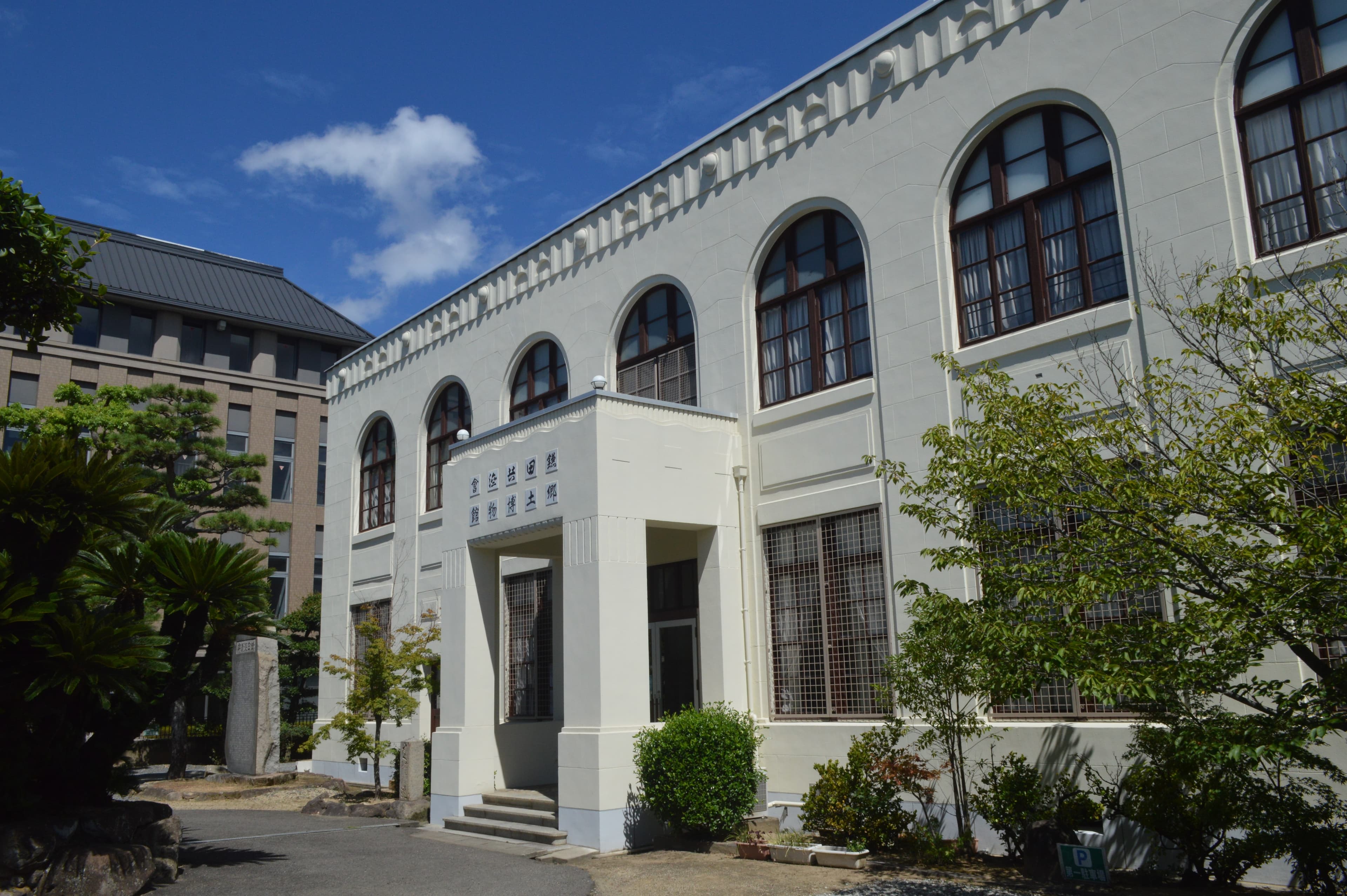
Go in knowing exactly what you're getting: a real, unhurried local history museum, not a Murakami shrine. There's no sign inside connecting it to the novel, no gift-shop nod to Kafka Tamura — Murakami said, in his own words, that he made the library up, and the museum has never claimed otherwise. What you're chasing here is atmosphere, not confirmation: the hush of an old private collection, the specific quiet of a building that was somebody's passion project before it was anybody's tourist stop.
That's worth sitting with for a minute before the transit details take over. This is the closest a reader gets, anywhere in the world, to standing inside the idea of the Komura Library — even knowing, walking in, that the real thing is fiction.
- Getting there: A short walk from JR Sakaide Station on the Yosan Line, around 15–20 minutes by train from Takamatsu Station — check current timetables, since a rapid or local service changes the ride by a few minutes either way.
- Good to know: Free admission, roughly 9:30–16:30 with a last-entry cutoff, closed Mondays and around the New Year and Obon holidays — hours at small municipal museums shift, so confirm before you go rather than building a tight schedule around them.
In the novel: Takamatsu and Nakano
Takamatsu itself — Kafka's destination, and Shikoku's largest city — is real and worth a wander on its own terms, even though the novel doesn't tie him to other specific, identifiable addresses here. Picture the texture instead: a quiet port city on the Seto Inland Sea, the kind of place a runaway could disappear into ordinary daylight rather than drama. If you want somewhere to sit with the book itself, Ritsurin Garden — one of Japan's great surviving Edo-period gardens — is a short walk from the station.
Nakano, Tokyo, where Kafka starts, is a real, dense central-Tokyo ward, but the book never marks a particular building or street as his father's house.
Neither city hands you a plaque to stand in front of. What they hand you instead is the shape of the journey itself — the same distance, the same direction, that a runaway fifteen-year-old covered by bus.
Practical travel notes
- Best time to visit: Takamatsu and Sakaide are pleasant most of the year; spring and autumn avoid Shikoku's hottest, most humid stretch.
- Base yourself in: Takamatsu, with Sakaide folded into a Takamatsu day rather than treated as its own dedicated outing — it's closer to an hour or two round trip, museum included, than a half-day trip.
- Worth it?: If you're not already invested in the book, this is a niche detour — a small local museum with no explicit connection to the novel on site. If you are invested, it's the closest thing that exists to walking into the idea of the library, and worth the short trip out from Takamatsu.
- The book itself: the standard English translation is by Philip Gabriel.
Tabi Tales may earn a commission from hotel, tour, and book links on this page at no extra cost to you. See our affiliate disclosure for details.