Natsume Soseki · Kyushu, Kumamoto
Following Natsume Soseki's Kusamakura to Kumamoto: A Literary Travel Guide
Trace the real hot-spring village behind Natsume Soseki's Kusamakura — a remote corner of Kumamoto Prefecture where a Meiji-era villa, its mirror pond, and an old mountain road still match the novel almost exactly.
A painter walks into the mountains carrying almost nothing — a sketchbox, some vague ambition to think seriously about beauty — and simply stays there, detached from the human noise of the valley below, watching light move across a garden pond. Nothing much happens in Kusamakura (草枕, "The Grass Pillow," 1906) in the way a plot usually happens. That's the point: Soseki wrote it as a deliberate experiment in looking at the world the way a painting looks at its subject, without the friction of story getting in the way.
He didn't invent the setting from nothing. Soseki made the same trip himself, over the New Year holiday spanning 1897 into 1898, while teaching English in Kumamoto, to a hot-spring hamlet then called Oama — today part of Tamana City, a quiet corner of Kumamoto Prefecture that still calls itself "Kusamakura no Sato," the village of Kusamakura. This is the least convenient stop in this series to actually reach, and also the one where the real geography lines up most closely with the fiction — worth the detour if you want to stand somewhere a Soseki setting has barely changed.
Stop 1: Maeda Villa, Oama Onsen — the house behind the novel
The painter in Kusamakura stays at a real house: the retirement villa of Maeda Kaseki, a Meiji-era Freedom and People's Rights politician, where Soseki himself was a guest over that New Year's trip. The villa survives — now preserved within the Kusamakura Exchange Hall (草枕交流館) in Oama — with its six-mat guest room and an old bathhouse said to date from the same era still intact.
Beside the house sits the garden pond locally identified as the real-world model for Kagami-ga-ike, the novel's "Mirror Pond." It matters more than a pretty name suggests. The painter keeps returning to this pond throughout the book to watch the innkeeper's daughter, Nami, at its edge — a woman he's trying, and mostly failing, to see purely as an aesthetic composition rather than as a person he has feelings about.
The pond becomes the place where his whole theory of detached, non-emotional looking is quietly tested against an actual human face. Stand at the edge of the real pond and that's the scene worth holding in mind — not a garden feature, but the spot where the novel's argument with itself plays out.
- Getting there: There's no train to Oama. From Kumamoto City, the most reliable route is by car (roughly 40–50 minutes); a local bus toward "Oama Onsen" exists but runs on a sparse schedule, so check current timetables before relying on it. A JR Kagoshima Line train to Tamana Station followed by a taxi is a workable alternative, though it's not necessarily faster once you add up the connections — worth comparing both against current schedules rather than assuming either one saves time.
- Good to know: The villa has been through renovation closures in the past, so check current hours before making the trip out — this is remote enough that showing up to a closed building is a real risk, not just an inconvenience.
Stop 2: Kusamakura Onsen Tensui
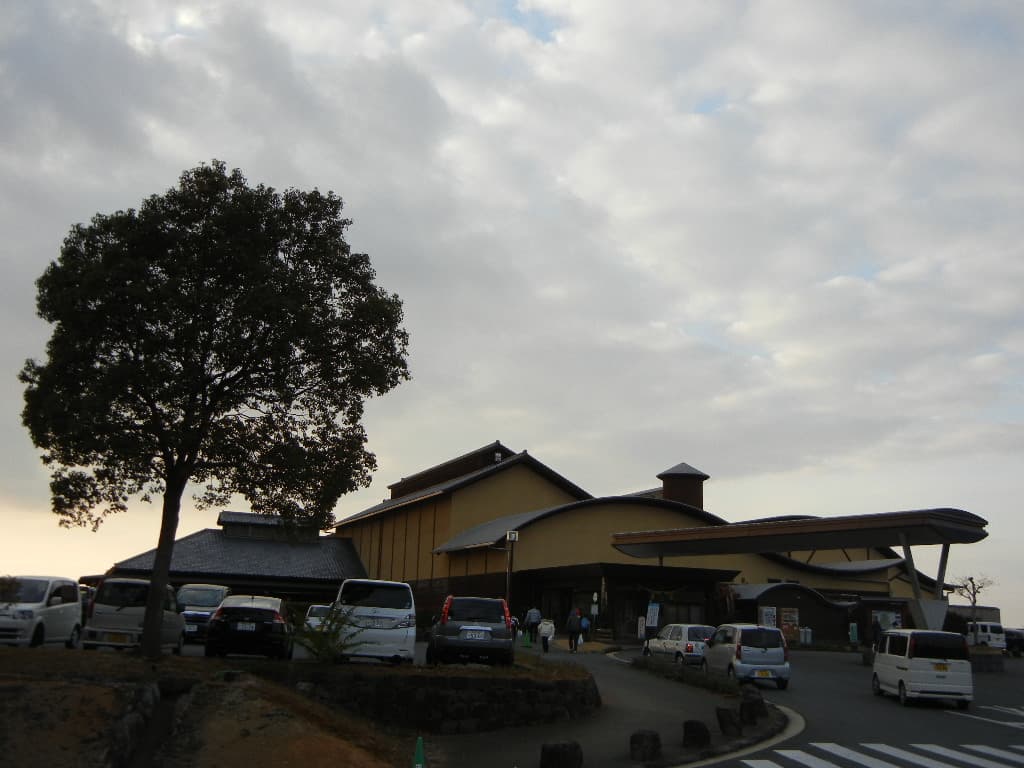
A short walk from the villa, this public bathhouse-and-exhibition facility leans fully into the novel's namesake, with a bath called "Kusamakura no Yu" and an observation tower looking out over the Ariake Sea toward Mt. Unzen. It's a good, low-key way to actually soak in the setting rather than just look at it.
- Getting there: Walking distance from the Maeda Villa / Kusamakura Exchange Hall in Oama.
- Good to know: Admission is inexpensive, around ¥500. Bring a translation app — there's minimal English signage this far outside Kumamoto City.
Stop 3: The old Kumamoto–Oama road
The novel's mountain-pass teahouse scene draws on real teahouses that once lined the old road between Kumamoto and Oama, over the Toriigoe and Noide passes. Little remains to formally visit, but if you're traveling by car rather than taxi, following this older route rather than the main road gives a better sense of the walk the painter — and Soseki — actually made.
- Getting there: Only practical by car; not signposted as a tourist route.
- Good to know: This is a nice-to-have for readers who want to trace the full journey, not a required stop.
Practical travel notes
- Best time to visit: Spring, when Tensui's plum and peach blossoms are in bloom, or autumn. Avoid Kyushu's rainy season in June.
- Base yourself in: Kumamoto City — Oama itself has almost no lodging beyond the small ryokan Nakoi-kan, whose name echoes Nakoi, the novel's fictional setting.
- Language: This is rural Kyushu with very little English signage — a translation app is essential here, more so than for any other stop in this series.
Tabi Tales may earn a commission from hotel, tour, and book links on this page at no extra cost to you. See our affiliate disclosure for details.